
One Rises and Pulls the Other Up: Mônica da Cruz Silva on the Yardstick Women Use to Measure Themselves
Solutions architect and KAURA founder Mônica da Cruz Silva on bridge-spotting, the wrong yardstick, and why a mentor’s job is not to hold on.
Mônica da Cruz Silva, Solutions Architect, Founder of KAURA
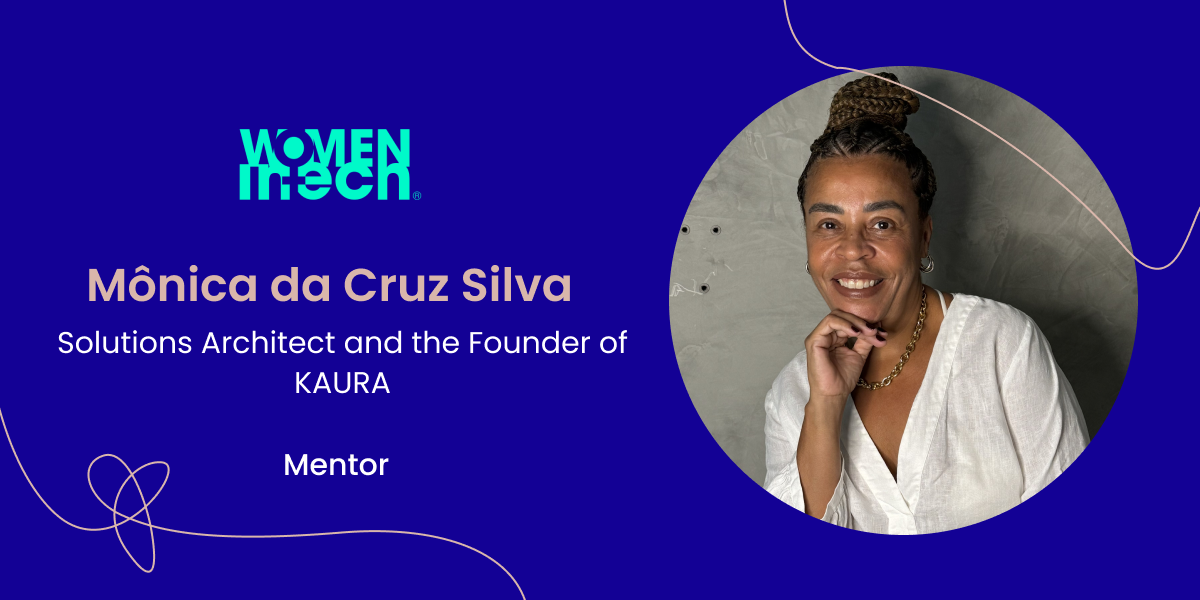
“A mentor’s job is not to hold on. It’s to prepare her for the moment she won’t need to come back.”
Mônica da Cruz Silva is based in Niterói, Rio de Janeiro, Brazil. She is a solutions architect and the founder of KAURA, where she works at the intersection of projects, data, and applied AI, solving complex problems by building from scratch rather than following a ready-made recipe.
Much of her work today is digital transformation in the public sector. She has used AI since 2020. Through KAURA, she mentors women in tech, and she is writing a book based on the patterns she has observed along the way.
Mônica takes part in the Women in Tech mentorship program as a mentor.
What She Recommends
Rather than a book, Mônica offers an exercise she created in her mentoring practice at KAURA, which she calls bridge-spotting. “Once a day, write one line connecting something you did at work to the role or area you want to reach. Most women I mentor aren’t missing skills. They’re missing the bridge between what they already do and where they want to go.” She explains the purpose behind it. “The idea is that, after a few weeks, the list stops being a feeling and becomes evidence, and evidence is much harder to argue with.”
Recognizing Patterns She Had Lived Herself
Mônica’s motivation to mentor comes from seeing herself in the women she works with. “I kept recognizing in other women patterns I had lived myself, long before I could name them. The competence was always there. What was missing was someone who could see it from the outside.”
She describes the moment she finds most rewarding, and how quietly it tends to arrive. “The most rewarding moment is when she finally sees herself the way I’ve been seeing her. It rarely comes as a celebration. It usually comes as a silence.”
The Wrong Yardstick
Mônica recalls a mentee who went pale when her name was announced for a role the company had created specifically because it needed someone like her. “I could have read it as emotion, but it wasn’t. It was an old, silent, very fast calculation: ‘they’ll find out I’m not enough.’”
Mônica traces that reaction to its source. “The problem was never competence. It was the yardstick she used to measure herself, built on a path she never had access to, not for lack of ability but because of circumstance.” That shaped her approach. “As long as that yardstick was wrong, no achievement would ever fit inside her. So before offering any tool, I needed to understand where that measure came from. That was the diagnosis, and only then came the tool.”
Learning to Listen for What Isn’t Said
Mônica describes mentoring as sharpening her ability to observe. “I learned to listen to what a woman doesn’t say, and to diagnose before I offer anything.” One experience in particular reshaped her understanding of what success in mentoring actually looks like. A mentee grew so quickly that she simply stopped coming back, and it took Mônica weeks to name what she felt. “What I learned from her is something I now carry into every mentorship. A mentor’s job is not to hold on. It’s to prepare her for the moment she won’t need to come back.”
Her Advice to First-Time Mentors
Mônica encourages new mentors to lead with attention rather than answers. “You don’t need to have all the answers. You need to pay attention. Your own path, including the parts you’d rather forget, is what will let you recognize what she can’t see yet.” She adds a note on approach. “Don’t arrive with a recipe: ask first, understand, and only then choose what to offer. And be ready to learn as much as you teach.”
Why She Believes Mentorship Matters
Mônica connects mentorship directly to the gap between competence and self-perception. “Competence alone doesn’t make a woman see herself. Many of the most capable women I’ve met measure themselves with a yardstick that was never theirs. Mentorship offers the mirror nobody offered them.”
She closes with a reading of the OneUpOneDown name itself. “When I look at the OneUpOneDown logo, I read it the way we’d say it in Portuguese: ‘uma sobe e puxa a outra,’ one woman rises and pulls the other up. That’s what mentorship is for.”
Following Her Journey
Mônica shares more about her work on LinkedIn and Instagram.
Ready to start your own mentorship journey?
The Women In Tech mentorship program connects professionals with mentors who have walked the path before them.
Join the Program