
The Gap Between What You Can Do and What You Believe: Mihaela Nica on Mentoring in Tech
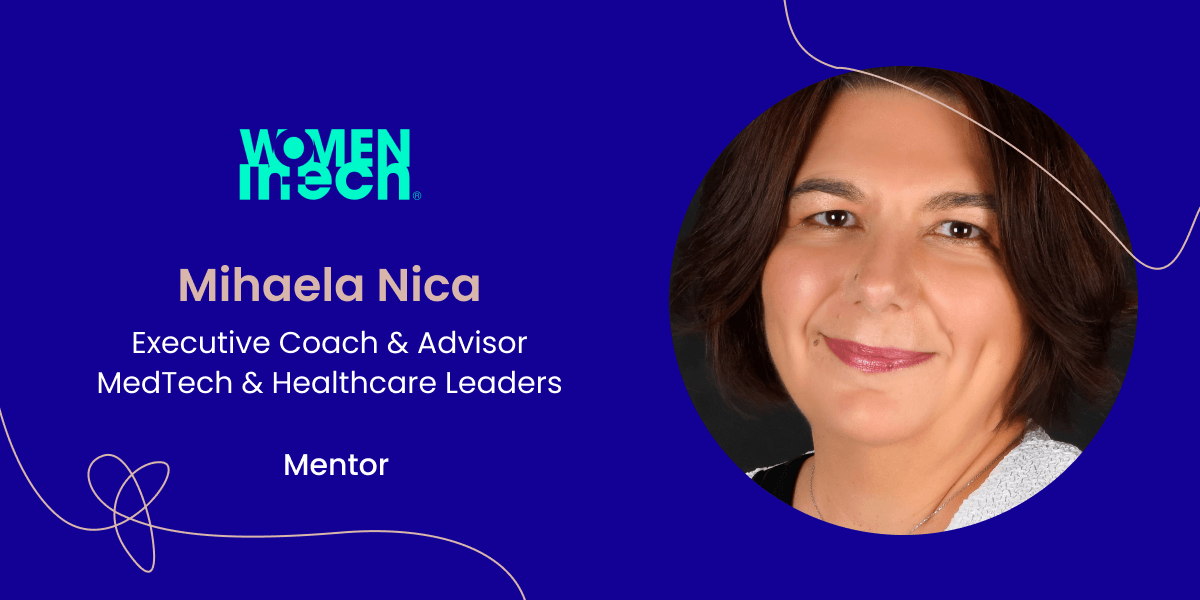
An ICF PCC executive coach based in Bucharest with nearly 20 years in MedTech and life sciences, Mihaela Nica explains why building on strengths rather than fixing weaknesses unlocks careers, and why a mentor shows you the path exists.
"A mentor doesn't hand you the answers. She shows you that the path exists, that someone walked it, and that the doubts you have are normal and survivable."
Mihaela Nica is based in Bucharest, Romania, though her clients are spread across many countries and most of her work happens online. She is an executive and leadership coach, credentialed as an ICF PCC and a Gallup Certified Strengths Coach, working with leaders who are stepping into bigger roles or trying to hold their ground in the ones they already have.
Before coaching, she spent nearly 20 years in strategic marketing and business development at 3M, Ecolab, and Smiths Medical, across MedTech and life sciences in EMEA. "In that time I worked with people from almost 100 nationalities, which is probably the part of my background that shows up most in how I coach today."
Mihaela takes part in the Women in Tech mentorship program as a mentor.
Passing On the Support She Once Had
Mihaela traces her decision to mentor back to the women leaders who supported her throughout her career, even without a formal program.
"I was never part of a formal mentorship program, but I always had someone to ask for advice or brainstorm with when I needed it. I was encouraged when it mattered, and I know how much difference that makes for anyone. Mentoring is my way of passing that on."
What she finds most rewarding is watching a mentee finally act on something she had been putting off. "The most rewarding part is watching a mentee take a decision she had been avoiding for months, once someone helps her see it clearly."
A Moment That Keeps Repeating: Shifting From Weaknesses to Strengths
Rather than one specific success story, Mihaela points to a pattern she sees again and again. "I'm always struck by how people react when we start exploring their talents and strengths, what they actually bring to a team or an organization. Every person has a unique combination of talents, so her contribution is unique too."
She describes what changes once that shift happens:
"The shift happens when we stop trying to fix weaknesses and start building on what's already strong. Suddenly things become 'easier,' 'doable,' 'rewarding,' 'enjoyable,' to use the words I hear most often. That shift never stops impressing me, and it unlocks opportunities people didn't see before."
How Mentoring Has Shaped Her
Mihaela describes mentoring as a check on her own thinking.
"A mentee will ask 'why' until you either have a real answer or admit you don't. That has sharpened how I think about my own experience, what actually worked and what I just got away with."
She adds that it keeps her current. "It has also kept me close to the reality of women building careers in tech right now, which is different from what I lived through, and I need to see that clearly to be useful."
Her Advice to First-Time Mentors
Mihaela pushes back on the idea that a mentor needs to have everything figured out.
"You need to be a few steps further along and be willing to share your experience and say what you really think. Listen more than you advise, don't try to make the mentee a copy of you, and don't confuse mentoring with fixing. If you're waiting until you feel qualified, you'll wait forever."
Why She Believes Mentorship Matters
Mihaela connects mentorship to the gap between competence and self-belief. "The gap between what women in tech can do and what they believe they can do is still wide, and it is hard to close it alone."
She points out this isn't unique to women, though the willingness to seek mentoring often differs. "The difference is that men are usually more self-confident or bolder about asking for mentoring in the first place."
She describes what a mentor actually offers:
"A mentor doesn't hand you the answers. She shows you that the path exists, that someone walked it, and that the doubts you have are normal and survivable. That could save years and accelerates careers."
What She Recommends
When asked for a book, tool or resource recommendation, Mihaela points to the CliftonStrengths assessment from Gallup.
"Most of us are trained to look at what's wrong with us and fix it. CliftonStrengths does the opposite: it gives you a language for what is right with you, your natural patterns of thinking, learning and acting, the ones that actually drive your results."
She recalls how one client described it. "A tech leader I worked with put it best: 'It's like reading my own operating manual.'"
For a book, she recommends The Myths of Happiness by Sonja Lyubomirsky. "It takes apart the idea that the next promotion, the next move or the next job will finally make things click. Many of the women I work with are chasing exactly that. The book is well researched, easy to read, and it changes how you look at your own life and career decisions."
Thank you, Mihaela, for reminding us that the fastest way forward is often to build on what is already strong, and for helping close the gap between what women in tech can do and what they believe they can do.
Ready to close the gap between what you can do and what you believe?
Mihaela's story shows that the doubts you carry are normal and survivable, and that the right mentor can save you years. Join the Women In Tech mentorship community and find someone who has walked the path before you.
Join the Program